Flat roofs in Wichita: where the water goes is the whole job
A flat roof isn't flat; it's a low slope that has to move water to a drain or an edge before the sun bakes it or the ice freezes it in place. Most flat-roof leaks are ponding, seams or flashing. Fixing them starts with finding where the water sits.
Low-slope roofs around Wichita cover more than you'd think: the additions and sunrooms tacked onto ranch houses, porch and carport roofs, mid-century homes with their nearly flat lines, detached garages and shops, and most of the commercial buildings from the strip centers on Kellogg to the hangars and warehouses around the aircraft plants. They fail differently from shingle roofs and they're repaired with different materials, which is why a shingle roofer looking at a flat roof often reaches for a bucket of mastic and makes it worse.
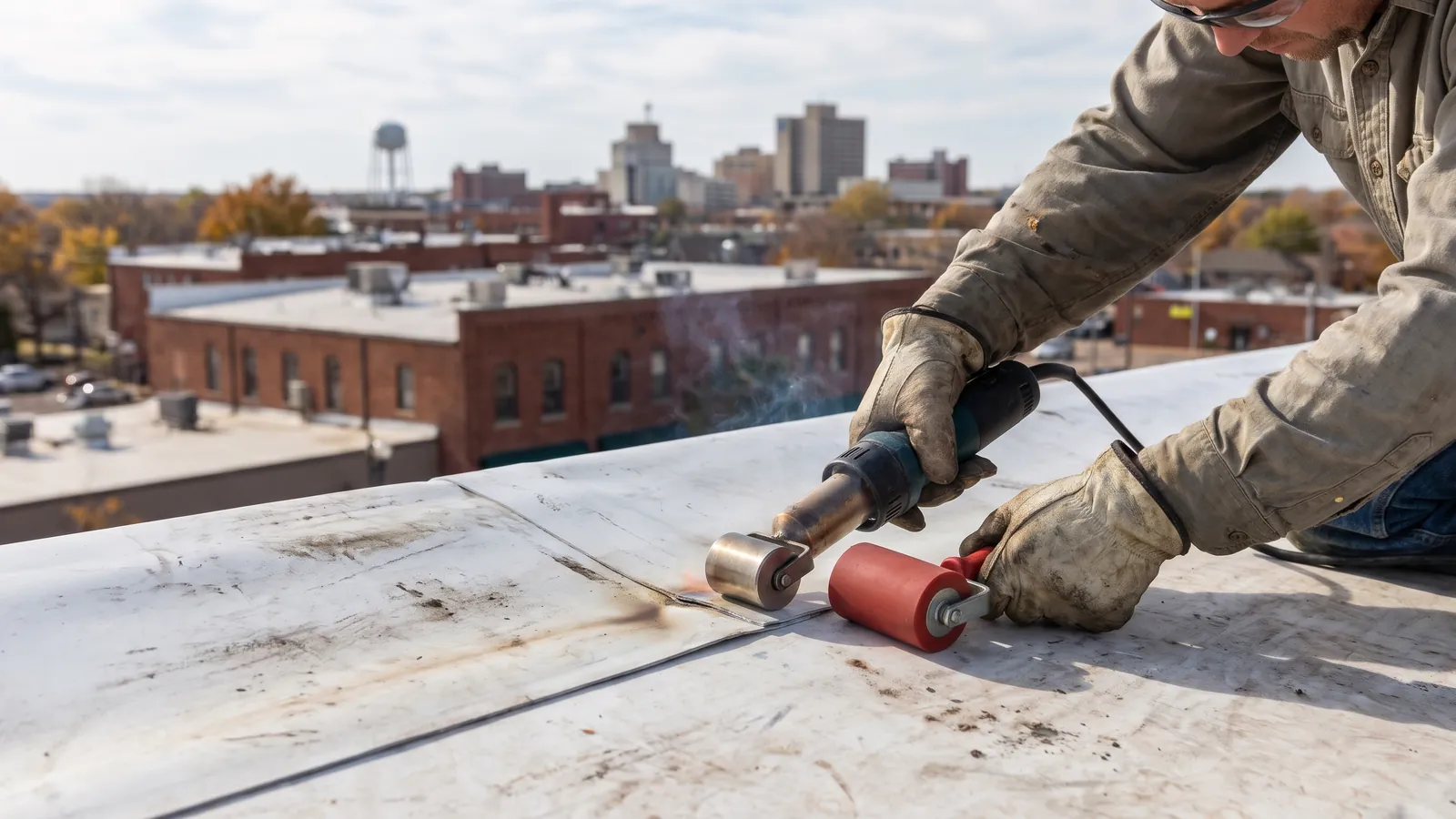
Three membranes do nearly all the work here. TPO is the white single-ply sheet on most new commercial roofs and a lot of residential flat sections: reflective, heat-welded at the seams, mechanically fastened or fully adhered, twenty to twenty-five years when installed well. EPDM is the black rubber sheet, long-lived and forgiving, with glued seams and a track record of thirty years in the Midwest; it runs hotter in summer. Modified bitumen is the granulated asphalt roll roofing on older low-slope roofs, torched or cold-applied in two layers, tough underfoot and easy to patch. We repair all three and replace with whichever fits the building, the budget and the foot traffic.
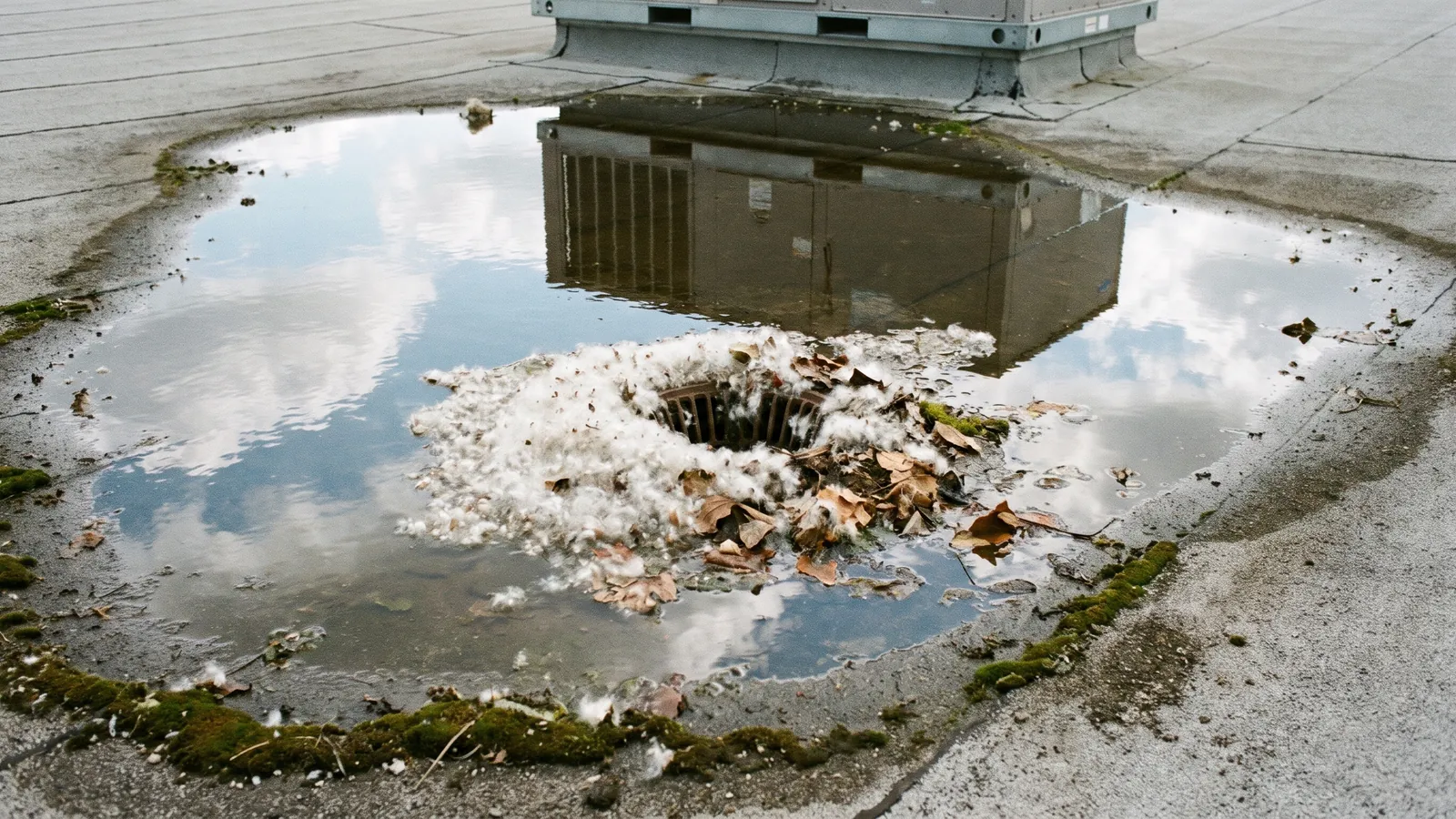
The inspection follows the water. Where it ponds (standing more than 48 hours after rain) the membrane ages fastest and the ice does the most damage, and the fix is usually tapered insulation or an added drain rather than another coat. Seams are checked by hand and by probe; a TPO seam that was welded cold or an EPDM seam whose adhesive gave up lets water in with no sign on the surface. Flashing at curbs, parapets, pipes, skylights and the wall where the addition meets the house is the other common leak, often because the wall counter-flashing was caulked and never terminated. Drains and scuppers clogged with cottonwood fluff turn a good roof into a pond in one June storm.
Hail matters on flat roofs too. Large hail bruises and can fracture a membrane over hard insulation, and it shreds an aging modified bitumen surface; adjusters test flat roofs with core samples and infrared scans rather than chalk squares, and we document them the same way. Commercial owners should read the commercial page for maintenance plans; homeowners with a flat section on a shingle house get it inspected with the rest of the roof, free.
Signs it's time to call
- Puddles still on the roof two days after rain
- Bubbles, wrinkles or lifted seams in the membrane
- A stain where an addition or porch meets the house
- Gravel or granules washing off a modified bitumen roof
- Water backing up at a drain or scupper after storms
- A commercial roof that's been coated more than once
What the roofer does
Follow the water
Ponding mapped, drains and scuppers cleared and checked, slope measured, so the repair fixes the cause and not the puddle.
Seams probed, not eyeballed
TPO welds and EPDM laps tested by hand and probe along their length; failed sections re-welded or stripped in.
Flashing terminated properly
Curbs, parapets, pipes, skylights and the house wall re-flashed with the membrane's own system and a real termination bar, not a bead of caulk.
Right membrane for the building
TPO, EPDM or modified bitumen matched to the roof's use, traffic, heat and budget, explained in plain words.
Tapered insulation where needed
Added slope and added drains on replacements so standing water stops being the roof's main problem.
Hail documented the flat-roof way
Core samples and photographs of membrane fractures and crushed insulation, in the format adjusters expect.
Flat roofing cost in Wichita
| Work | Planning range | What moves it |
|---|---|---|
| Flat roof inspection with moisture check | Free | Residential and small commercial |
| Seam or flashing repair, TPO or EPDM | $400 – $1,500 | Length and access |
| Modified bitumen patch | $350 – $1,200 | Torch or cold-applied |
| Drain or scupper added | $600 – $1,800 | Through-wall scuppers less; interior drains more |
| TPO replacement, fully adhered, 60-mil | $700 – $1,200 per square | Insulation and tear-off vary |
| EPDM replacement, 60-mil | $650 – $1,100 per square | Black; white options available |
| Modified bitumen two-ply replacement | $600 – $1,000 per square | Good for small residential sections |
| Tapered insulation package | +$150 – $350 per square | Where ponding must be designed out |
Planning ranges for the Wichita area in 2026, not quotes. Your number is the itemized written estimate after the inspection, good for 30 days, with no deposit due until you approve it. The MABCD permit, when one applies, is its own line.
On the job
Questions about flat roofing
Why does my flat roof leak only in heavy rain?
Because that's when the water rises above a seam, a flashing termination or a low scupper. Light rain drains before it finds the hole. We flood-test or probe the suspect areas instead of guessing.
Can you coat it instead of replacing it?
Sometimes. A silicone or acrylic coating over a sound, dry, well-adhered membrane buys years. Over a wet, ponding or seam-failed roof it buys a shiny leak. We'll check the moisture first and tell you which you have.
TPO or EPDM for a house?
TPO if the section is over living space and you want the reflectivity; EPDM if it's a garage or porch and you want the simplest, longest-lived sheet. Either way, 60-mil over 45.
Is a flat roof covered by insurance for hail?
Yes, as part of the dwelling, with the same deductible. Adjusters look for membrane fractures and crushed insulation rather than bruises; we document both and meet them on the roof.
How long does a flat roof last in Kansas?
Twenty to twenty-five years for TPO, up to thirty for EPDM, fifteen to twenty for modified bitumen, all assuming drains are kept clear and ponding is addressed. Standing water halves those numbers.
Do you handle the addition where it meets the house?
That junction is the most common residential flat-roof leak and we flash it as a wall, with the membrane turned up behind the siding or counter-flashed into the brick, not sealed with caulk.